


Weather's cooled down a bit, that's nice
5 Jul 2025 07:29 pm![[personal profile]](https://www.dreamwidth.org/img/silk/identity/user.png) conuly
conuly( Read more... )
Purrcy; Pride
3 Jul 2025 12:20 ammecurtinWhat's that in the sky? he wondered, after several days of rain & thunder-growler attacks.
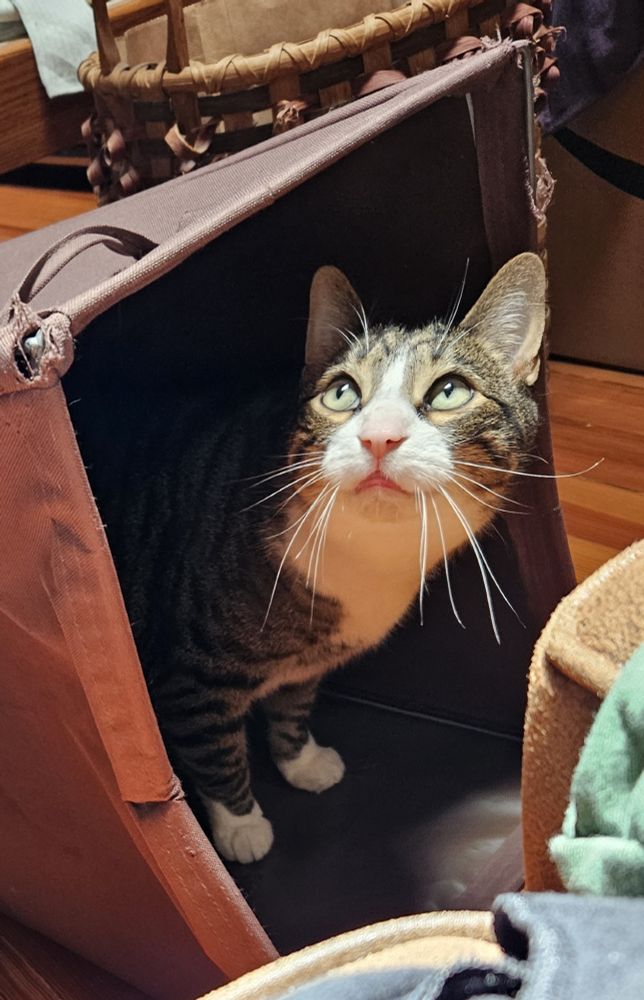
My back continues to be better, while not being anything like *all* better. Prednisone has the reputation of being Side Effects City, my biggest ones so far are dry mouth making my voice all scratchy, and a certain amount of ADHD/mania type behavior, trouble settling & sleeping. Only 3 more days of tapering to go, though.
Amid all The Horrors ramping up & up, here's something that's given me active joy in the past couple of days: Sir Ian McKellan joining Scissor Sisters onstage at Glastonbury Festival:
My god, he's still got that full Royal Shakespeare voice.
It makes me cry a bit with joy at the end there, seeing Sir Ian being able to lead his people in a public celebration of being out & proud. And to see an old man being *venerated*, for once, admired for achievements but in this case also as a symbol of what people like those in the audience can have with age: a *full* life, a *long* life, a life with everything in it, despite what they may have been told. You don't have to be young to be queer, it's not a phase, it's part of a complete human life.
Daily Happiness
2 Jul 2025 09:21 pmtorachan2. Just one more day of work this week and then three day weekend!
3. Finished another puzzle today. This is from the multi-puzzle box of Disney 70th anniversary puzzles. I really love this design, and they've got a fair bit of merch using it, too, but sadly not anything I actually need (and not even much that I particularly want).

4. Chloe loves lying on Carla's bed by the window.

(no subject)
2 Jul 2025 11:38 pmconuly posting in ![[community profile]](https://www.dreamwidth.org/img/silk/identity/community.png) agonyaunt
agonyauntOur house sits on a heavily wooded hill, and there isn’t much in terms of street lights—and no sidewalks. Though there are only a few houses on our bend of the road, we get people speeding through. We have new neighbors. The mother’s behavior is going to end in tragedy.
The neighbors have several very small children. The mom, for some unholy reason, thinks nothing of letting them bike in the street. She lets her babies ride around well ahead of her as she strolls leisurely several yards behind. I wouldn’t have believed it if I hadn’t seen it myself.
My husband has already had a close call with one of the kids. He was backing out and the toddler zoomed right behind the bumper. Luckily, my husband was paying attention and was fast to put his foot on the brake. Even going as slow as he was, just a few miles per hour, it would have been a tragedy if he hadn’t been alert.
The mother’s reaction was to lay into my husband for not being careful enough! The kicker is that she said her kids have a right to play in the street. (There is a park five blocks away, but that is too far for her to go, apparently.) My husband said it was a bad conversation.
What do we do here? It would haunt me if one of these kids got hit because their mother was too lazy to care.
—Blind Corner
( Read more... )

A Song on the End of the World by Czeslaw Milosz
3 Jul 2025 05:00 pmconulyA bee circles a clover,
A fisherman mends a glimmering net.
Happy porpoises jump in the sea,
By the rainspout young sparrows are playing
And the snake is gold-skinned as it should always be.
On the day the world ends
Women walk through the fields under their umbrellas,
A drunkard grows sleepy at the edge of a lawn,
Vegetable peddlers shout in the street
And a yellow-sailed boat comes nearer the island,
The voice of a violin lasts in the air
And leads into a starry night.
And those who expected lightning and thunder
Are disappointed.
And those who expected signs and archangels’ trumps
Do not believe it is happening now.
As long as the sun and the moon are above,
As long as the bumblebee visits a rose,
As long as rosy infants are born
No one believes it is happening now.
Only a white-haired old man, who would be a prophet
Yet is not a prophet, for he’s much too busy,
Repeats while he binds his tomatoes:
There will be no other end of the world,
There will be no other end of the world.
Warsaw, 1944
Link
(no subject)
2 Jul 2025 04:59 pmwaterswordFace of sadness & rage: the public library here has had to cut its streaming services, likely in part because of the destruction of the IMLS, which funded a lot of that. This is a fucking travesty.
It's been too hot to bake, so I picked up a loaf of bread and am basking in the season's first tomato sandwiches. Bliss.
One thing I want to do before the end of the summer is borrow the ice cream maker and dehydrator from the Thing Library; my ice cream quest continues (Dutch Chocolate is perfectly fine but not a standout); blueberrying has not been scheduled but I have agreement that it sounds like fun from the people I want to go with. I am up to H.M.S. Surprise in the Aubreyad and enjoying myself thoroughly.
I love summer so much. I feel like a person.
2025 Disneyland Trip #46 (7/1/25)
2 Jul 2025 08:56 amtorachan( Read more... )
LEP 2.7.
2 Jul 2025 03:23 pmyvannairieI should remember, that every time I feel like my blorbo is being sidelined by the fandom in favour of a more photogenic ship, I am not alone. After all, Rostand wrote Cyrano de Bergerac in 1897.
Daily Happiness
1 Jul 2025 11:50 pmtorachan2. I got my hair cut today. Cannot stress enough how great it is to have that next appointment already scheduled and not have to deal with having to make the appointment when my hair is starting to bother me. It's already in the calendar! And to go to someone who knows exactly what to do without me telling them every time!
3. The tri-tip Carla grilled on Sunday has indeed made delicious sandwiches. And we still have a ton left so there will be sandwiches all week.
4. Carla was having a high anxiety day so as a mood booster we went down to Disneyland for dessert tonight. Had a very nice trip.
5. Molly's got her eye on you.

Five Things Rhine Said
1 Jul 2025 04:02 pm![[syndicated profile]](https://www.dreamwidth.org/img/silk/identity/feed.png) ao3_news_feed
ao3_news_feed

Every month or so the OTW will be doing a Q&A with one of its volunteers about their experiences in the organization. The posts express each volunteer's personal views and do not necessarily reflect the views of the OTW or constitute OTW policy. Today's post is with Rhine, who volunteers as a volunteer manager in the Translation Committee.
How does what you do as a volunteer fit into what the OTW does?
As a Translation volunteer manager I mostly deal with admin work that surrounds the work our translators do – be it talking to other committees about things that are to be translated, preparing English texts for translation, making sure our version of the text is up to date, or getting texts published once they are translated – along with more general personnel stuff like recruiting new translators, keeping a clear record of who is supposed to be working on what and who is on break, checking in with translators and how they feel about their work, that kind of thing. Having been in this role for some time now, I also help with mentoring newer volunteer managers in how to do what we do, at the scale we do it.
What is a typical week like for you as a volunteer?
There isn't one singular stereotypical week in this role, but some different modes with different focuses that are more or less typical for me:
- Going on-call for a week: Translation volunteer managers work from a shared inbox that serves as a first point of contact for all inquiries related to the Translation Committee. Each week, one or two volunteer managers go on-call as the ones primarily responsible for making sure everything gets actioned and squared away as needed. This usually means spending a couple hours each day working through everything in the shared inbox, including but not limited to assigning tasks to translators, checking on translators who were on hiatus, triaging translation requests from other committees, and responding to any questions translators may have in the course of their work.
- Working on a bigger project, like a series of high-visibility posts (e.g. membership drive, OTW Board elections), opening recruitment, or internal surveys: When Translation does a committee-wide thing, it'll by necessity involve most or even all of our forty-some language teams, each with 1–8 members. Coordinating all that takes some organisational overhead (and some love for checklists and spreadsheets, along with automations where feasible), which typically means sitting down for a few hours on three or four days of the week and chipping away at various related tasks to keep things moving, including but not limited to asking other people to double-check my work before moving on to the next step.
- Working on smaller tasks: When I want to have a more relaxed week while still being active, I'll sit down on one or two afternoons/evenings, and take care of a task that is fairly straightforward, like scheduling and leading chats to check in with translators or train people on our tools, creating a template document with English text for translation, drafting and updating our internal documentation, asking others to look over and give feedback on my drafts, and giving feedback on others' tasks, drafts, and projects.
- Weekly chair training/catch-up chats: We have a regular weekly meeting slot to sit down and talk about the few chair-exclusive things in the Translation Committee, as part of chair training.
What made you decide to volunteer?
I actually started volunteering at the OTW as an AO3 tag wrangler back in 2020, when lockdowns were on the horizon and I felt like I could pick up some extra stuff to do. Growing up bilingual and with some extra languages under my belt, I ended up hanging out in some of the spaces with lots of OTW translators. Then I found out that I could internally apply as a Translation volunteer manager, and the rest is pretty much history. At that point I was missing the feeling of doing some volunteer management and admin work anyway!
What has been your biggest challenge doing work for the OTW?
On a high level, I'd say it's striking a balance between the expectations and the reality of the work the Translation Committee does, including the sheer scale. On a more concrete level, it's like this: Being a translator in the Translation Committee is, by default, a relatively low commitment, with a number of optional tasks and rosters that we encourage people to take on, if they have the time and attention to spare. Part of how we ensure that is by dealing with as much of the overhead in advance as we can, as Translation volunteer managers.
This means that for instance, when the English version of a text is updated – which may take about two minutes in the original text – we go through each language team's copy of the text, make the changes as needed in the English copy, highlight what was changed, and reset the status in our internal task tracker so that it can be reassigned to a translator. This way the changed part is clearly visible to the translator, so they can quickly pinpoint what they need to do and make the corresponding changes in the translated text.
For both the author of the original English text and the translator, this is a very quick task. On the admin side, on the other hand, it's the same two-minute process of updating our documents repeated over and over, about 15 times on the low end for frequent news post series that we only assign to teams that consistently have some buffer to absorb the extra workload, and almost 50 times on the high end for some of our staple static pages that (almost) all teams have worked on, meaning it's something that takes somewhere between 30 minutes to almost two hours even when it's a tiny change and you're familiar with the workflow.
(And that's before getting to very last-minute changes and emergency news post translations with less than two days' turnaround time, where we manually track everything across around thirty teams, usually. Each time that has happened, everyone's dedication has blown me away. Thank you so much to everyone who answers those calls, you know who you are!)
What fannish things do you like to do?
I like to read, especially if it's something that plays around with worldbuilding or other things that were left unsaid in canon. I wish there were more hours in the day so that I can pick up some of my creative projects again. I suppose some of my coding projects like my AO3 userscripts and my AO3 Saved Filters bookmarklet also count as fannish?
Now that our volunteer's said five things about what they do, it's your turn to ask one more thing! Feel free to ask about their work in the comments. Or if you'd like, you can check out earlier Five Things posts.
The Organization for Transformative Works is the non-profit parent organization of multiple projects including Archive of Our Own, Fanlore, Open Doors, Transformative Works and Cultures, and OTW Legal Advocacy. We are a fan-run, entirely donor-supported organization staffed by volunteers. Find out more about us on our website.
Five Things Rhine Said
1 Jul 2025 03:57 pmotw_news_feedEvery month or so the OTW will be doing a Q&A with one of its volunteers about their experiences in the organization. The posts express each volunteer’s personal views and do not necessarily reflect the views of the OTW or constitute OTW policy. Today’s post is with Rhine, who volunteers as a volunteer manager in the Translation Committee.
How does what you do as a volunteer fit into what the OTW does?
As a Translation volunteer manager I mostly deal with admin work that surrounds the work our translators do – be it talking to other committees about things that are to be translated, preparing English texts for translation, making sure our version of the text is up to date, or getting texts published once they are translated – along with more general personnel stuff like recruiting new translators, keeping a clear record of who is supposed to be working on what and who is on break, checking in with translators and how they feel about their work, that kind of thing. Having been in this role for some time now, I also help with mentoring newer volunteer managers in how to do what we do, at the scale we do it.
What is a typical week like for you as a volunteer?
There isn’t one singular stereotypical week in this role, but some different modes with different focuses that are more or less typical for me:
- Going on-call for a week: Translation volunteer managers work from a shared inbox that serves as a first point of contact for all inquiries related to the Translation Committee. Each week, one or two volunteer managers go on-call as the ones primarily responsible for making sure everything gets actioned and squared away as needed. This usually means spending a couple hours each day working through everything in the shared inbox, including but not limited to assigning tasks to translators, checking on translators who were on hiatus, triaging translation requests from other committees, and responding to any questions translators may have in the course of their work.
- Working on a bigger project, like a series of high-visibility posts (e.g. membership drive, OTW Board elections), opening recruitment, or internal surveys: When Translation does a committee-wide thing, it’ll by necessity involve most or even all of our forty-some language teams, each with 1–8 members. Coordinating all that takes some organisational overhead (and some love for checklists and spreadsheets, along with automations where feasible), which typically means sitting down for a few hours on three or four days of the week and chipping away at various related tasks to keep things moving, including but not limited to asking other people to double-check my work before moving on to the next step.
- Working on smaller tasks: When I want to have a more relaxed week while still being active, I’ll sit down on one or two afternoons/evenings, and take care of a task that is fairly straightforward, like scheduling and leading chats to check in with translators or train people on our tools, creating a template document with English text for translation, drafting and updating our internal documentation, asking others to look over and give feedback on my drafts, and giving feedback on others’ tasks, drafts, and projects.
- Weekly chair training/catch-up chats: We have a regular weekly meeting slot to sit down and talk about the few chair-exclusive things in the Translation Committee, as part of chair training.
What made you decide to volunteer?
I actually started volunteering at the OTW as an AO3 tag wrangler back in 2020, when lockdowns were on the horizon and I felt like I could pick up some extra stuff to do. Growing up bilingual and with some extra languages under my belt, I ended up hanging out in some of the spaces with lots of OTW translators. Then I found out that I could internally apply as a Translation volunteer manager, and the rest is pretty much history. At that point I was missing the feeling of doing some volunteer management and admin work anyway!
What has been your biggest challenge doing work for the OTW?
On a high level, I’d say it’s striking a balance between the expectations and the reality of the work the Translation Committee does, including the sheer scale. On a more concrete level, it’s like this: Being a translator in the Translation Committee is, by default, a relatively low commitment, with a number of optional tasks and rosters that we encourage people to take on, if they have the time and attention to spare. Part of how we ensure that is by dealing with as much of the overhead in advance as we can, as Translation volunteer managers.
This means that for instance, when the English version of a text is updated – which may take about two minutes in the original text – we go through each language team’s copy of the text, make the changes as needed in the English copy, highlight what was changed, and reset the status in our internal task tracker so that it can be reassigned to a translator. This way the changed part is clearly visible to the translator, so they can quickly pinpoint what they need to do and make the corresponding changes in the translated text.
For both the author of the original English text and the translator, this is a very quick task. On the admin side, on the other hand, it’s the same two-minute process of updating our documents repeated over and over, about 15 times on the low end for frequent news post series that we only assign to teams that consistently have some buffer to absorb the extra workload, and almost 50 times on the high end for some of our staple static pages that (almost) all teams have worked on, meaning it’s something that takes somewhere between 30 minutes to almost two hours even when it’s a tiny change and you’re familiar with the workflow.
(And that’s before getting to very last-minute changes and emergency news post translations with less than two days’ turnaround time, where we manually track everything across around thirty teams, usually. Each time that has happened, everyone’s dedication has blown me away. Thank you so much to everyone who answers those calls, you know who you are!)
What fannish things do you like to do?
I like to read, especially if it’s something that plays around with worldbuilding or other things that were left unsaid in canon. I wish there were more hours in the day so that I can pick up some of my creative projects again. I suppose some of my coding projects like my AO3 userscripts and my AO3 Saved Filters bookmarklet also count as fannish?
Now that our volunteer’s said five things about what they do, it’s your turn to ask one more thing! Feel free to ask about their work in the comments. Or if you’d like, you can check out earlier Five Things posts.
The Organization for Transformative Works is the non-profit parent organization of multiple projects including Archive of Our Own, Fanlore, Open Doors, Transformative Works and Cultures, and OTW Legal Advocacy. We are a fan-run, entirely donor-supported organization staffed by volunteers. Find out more about us on our website.
Ask A Manager: refusing to work for a customer for moral reasons,
1 Jul 2025 11:38 amminoanmiss posting in agonyauntthe extroverts were right
1 Jul 2025 12:40 pmcimoreneAnd he said close enough and gave me the student ticket rate.
Daily Happiness
30 Jun 2025 09:17 pmtorachan2. This may be my favorite picture of Tuxie ever. How is that comfortable!? Only a cat would think so.
